
Two factors decide your grinding process: material properties and production scale. Get either one wrong, and you waste money on a machine that clogs, overheats, or misses your particle size target. You also need the right outcome in mind. Grinding reduces size into granules or coarse particles. Pulverizing goes further and produces a fine, flour-like powder. That difference shapes your equipment shortlist before you compare a single price.
Hardness, moisture, target particle size, and heat sensitivity all steer the choice. So does scale, from small batch work to continuous large-scale output. This guide gives you a step-by-step way to match Pulverizing Equipment to both factors, whether you weigh a pin mill pulverizer machine or a multi-functional tabletop pulverizer, without overspending.
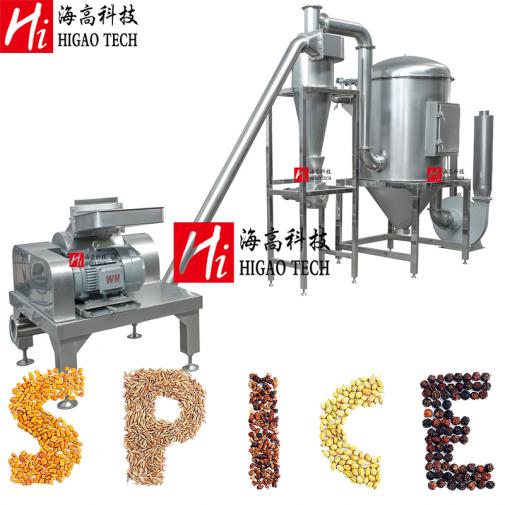
Start with hardness. The Mohs scale runs from 1 (very soft) to 10 (as hard as diamond). Soft materials need less energy to break down. Hard materials demand strong equipment that can generate the necessary force. Abrasive wear depends on the relative hardness of your material versus the grinding medium. Match them well, and the abrasive lasts longer with less wear.
Your material's hardness points toward a mill mechanism. Impact of the particle on the tool suits brittle, medium-hard materials. Tool movement on the particle works for softer stock. Particle-on-particle impact protects against contamination. Crushing with the tool handles coarse reduction. A pin mill pulverizer machine, for example, uses high-speed pins to strike particles and works well for many mid-range materials.
Quartz has a Mohs hardness of 7, so the milling system must withstand wear while delivering consistent ultra-fine powders. For high-purity applications requiring D97 below 5–10 microns, fluidized bed opposed jet mills are favored over simpler spiral designs because of their superior classification precision.
Abrasive minerals punish critical parts. Barite particles slide and collide with rolls and hammers, forming microscopic scratches that accumulate over time. This wear degrades grinding rolls, hammers, and pulverizer walls. The result is more frequent part replacements, unscheduled downtime, and higher maintenance costs. A wear-resistant hardfacing layer on high-wear areas mitigates the impact and extends equipment life.
Define your target outcome before you shortlist machines. Coarse grinding and fine, flour-like pulverizing powder call for different particle size targets. That target narrows your equipment list fast.
Moisture decides whether dry or wet processing fits. Dry grinding works best below 5% moisture content, which avoids blockages and equipment wear. Wet grinding needs above 50% moisture to form a smooth slurry and prevent clogging. Pre-dry wet stock when your process runs dry.
|
Grinding Method |
Recommended Moisture Content Limit |
Purpose |
|---|---|---|
|
Wet grinding |
Above 50% |
Smooth slurry, no clogging |
|
Dry grinding |
Below 5% |
Avoids blockages and wear |
Heat-sensitive materials need temperature control. Circulating water or air cooling, combined with cold-air feeding, holds the chamber from normal temperature down to about −10 °C. This suits moderately heat-sensitive items like green-tea powder and fruit-and-vegetable dry powder. Liquid-nitrogen deep cooling pre-cools material below −100 °C for extremely heat-sensitive, high-oil, or high-toughness stock. High-airflow designs such as jet mills avoid frictional heat entirely, because no mechanical parts touch the material.
Sticky and fibrous materials disrupt flow. Cohesive substances cause arching, bridging, and ratholing, which lead to blockages and lower output. Fibrous herbs wrap around rotating parts and obstruct grinding. Oily seeds can block screens when you choose the wrong mill. A material that looks dry can turn sticky as grinding raises its temperature. Check fiber content, stickiness, oil content, and heat sensitivity when you select Pulverizing Equipment.
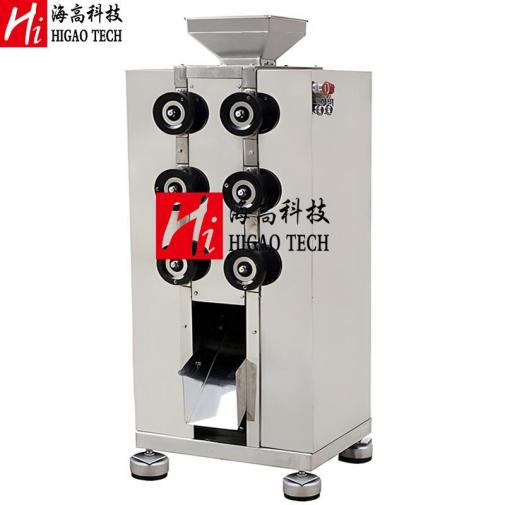
Scale selection rests on three things: your raw materials, your production requirements, and your long-term operating goals. A lab that tests ten samples a week needs different hardware than a plant running three shifts. Match the machine to the workload, not to the brochure.
Small batch work rewards flexibility over raw tonnage. Lab models such as the LabBM5 and LabBM10 handle 1–5 kg and 5–15 kg per batch respectively, while compact units like the RBM20 and RBM40 cover 15–30 kg and 15–60 kg per batch. Note that these figures are per batch, not per hour. A multi-functional tabletop pulverizer suits this tier well, because one bench unit can switch between small samples without a full teardown.
Pharmaceutical and food-grade labs often need tighter control. A scalable lab milling system can run from 5 g to 50+ kg/hr, with particle size distributions of 20–300 µm (d50) and 60–2000 µm (d90), depending on material and process goals. Bench mills go smaller still: a mixer mill handles sample amounts up to 20 ml, and a rotor beater mill accepts up to 30 l per batch with a cyclone attached.
Do not assume small means coarse. Basket and immersion mills reach micron to sub-micron sizes in small and mid batches, and ball mills can produce product as fine as 0.005 mm. The trade-off is throughput, which stays at a few kg/h.
Medium and large lines change the economics. A Raymond mill in medium-scale production delivers 5–20 tons per hour, or roughly 10,000–50,000 tons annually. A vertical roller mill in continuous large-scale service reaches 100–200 tons per hour and 100,000–1,000,000 tons per year. Capital tells the same story: small batch plants (1–5 TPH) run USD 40,000–80,000 total, medium plants (5–10 TPH) run USD 80,000–150,000, and continuous large-scale plants (10+ TPH) run USD 100,000–500,000 or more. Equipment's share of investment actually falls as scale rises, from 50%–60% down to 40%–50%, even as absolute cost climbs.
For food and feed, choose between a pulverizer and a hammer mill by working principle. A hammer mill spins hammers that strike material against chamber walls and a screen; hammer size, rotor speed, and screen size set the final particle size. It is simple and cost-effective for dry brittle grains, spices, and feed ingredients, but it gives a wider distribution and risks heat buildup or clogging with sticky, oily stock. A pin mill strikes material between two pinned discs and can go finer than a basic hammer mill. Turbine and ultrafine designs add airflow and classification for uniform fine powders, at lower capacity and higher energy cost as fineness rises.
Move from batch to continuous operation when your throughput outgrows batch handling and your particle size target stays stable. Batch suits frequent recipe changes and traceability; continuous suits steady, high-volume output. Select pharmaceutical or food-grade Pulverizing Equipment by capacity and desired particle size first, then confirm the hygienic design.
Work through a short checklist before you request quotes. First, assess the material: hardness, feed particle size, grindability, moisture, and any property you must preserve, such as surface area, particle shape, or contamination limits. Second, assess the scale: lab-sized or production-sized, wet or dry milling, and batch, continuous, or circulation operation. Third, match the mill to both answers.
|
Mill type |
Material property fit |
Production scale |
|---|---|---|
|
Ball mill |
High-hardness materials |
High-capacity projects |
|
Raymond mill |
Medium-fine powder |
Economical medium-scale processing |
|
HGM ultra-fine mill |
High-value ultrafine powders |
Ultrafine powder production |
A multi-functional mill pays off when you handle several raw materials and particle sizes. Sticky or oily stock, or a heat-sensitive batch, may call for a liquid nitrogen cryogenic pulverizer instead. Ease of disassembly and cleaning matters in food and pharmaceutical work, where cross-contamination is a real risk. Bring this checklist to a supplier such as Higao Tech and ask them to confirm the match against your own samples.
Now balance cost against performance. The right process meets your particle-size and throughput needs at the lowest total cost, not the most powerful machine. Coarse grades need less processing, which cuts energy and maintenance costs. Ultrafine grades demand jet mills or wet stirred mills with precise particle size distribution control, and those machines use more energy. Roller and vertical roller mills consume less power per ton than traditional ball mills. Ball mills cost less upfront but carry higher operating expenses for energy and wear. Weigh the full picture: fineness target, capacity, energy use, maintenance, and classifier integration. Then choose the Pulverizing Equipment that clears your requirements without overspending on capability you will never use.
Lock in the sequence before you buy:
Assess material properties.
Assess production scale.
Confirm the equipment match and run the cost check.
Then ask a supplier like Higao Tech direct questions. Which material are you grinding? What feed size and final mesh or micron target do you need? What hourly throughput must the line hit? Is the stock heat-sensitive, oily, or sticky? Do you need GMP or food-grade construction? Ask whether capacity figures come from real operating data or theory, and whether trials and spare parts support are available. A liquid nitrogen cryogenic pulverizer only makes sense when your answers flag extreme heat sensitivity.
The right process meets your particle-size and throughput needs at the lowest total cost.
Check your target particle size first. Grinding reduces material into granules or coarse particles. Pulverizing pushes further into a fine, flour-like powder. Your end product decides the goal, and the goal decides your equipment shortlist.
Rarely well. Hard stock demands wear-resistant parts and strong force. Soft stock needs gentler contact. A pin mill pulverizer machine covers many mid-range materials through high-speed impact, but you should confirm the match against your own samples before you commit.
Pre-dry wet stock for dry processing. Choose high-airflow designs for heat-sensitive items. For extreme cases, a liquid nitrogen cryogenic pulverizer pre-cools material below −100 °C and prevents oil or stickiness from blocking the chamber.
Yes, when flexibility matters more than tonnage. A multi-functional tabletop pulverizer lets one bench unit switch between small samples without a full teardown. Confirm whether capacity figures are per batch or per hour before you compare models.
Switch when your throughput outgrows batch handling and your particle size target stays stable. Batch suits frequent recipe changes and traceability. Continuous suits steady, high-volume output. Confirm the hygienic design for food or pharmaceutical work either way.


 русский
 English
 français
 Deutsch
 español
 português
 العربية
 Melayu
 ไทย
 Việt
 Indonesia
 Pilipino

